Showing posts with label Article. Show all posts

Friday, May 16, 2025

Where we can... #WritingPrompts4Community


Where we can... Written by Leonita Coutts 

I grew up humble... very humble and I know of hardship. In today’s economic climate, it’s heartbreaking to see how many people struggle to survive. I can also add that the COVID pandemic has contributed to this. 

The feeling of hopelessness: What are we going to eat or how are we going to survive until the end of the month? I know very well. 

No one wants to experience that feeling, believe me. 

Yes, life is challenging. Everyone has their personal “devils” or challenges they have to face. It is therefore difficult to focus on others when you yourself are busy scratching cabbages from the fire. 

In my town, as in many other towns and cities, there are people who have nowhere to go. They live and sleep in front of shops, under bridges or in alleys. Grace carries them and I call them “grace-men.” We don’t always know their past or the reason they live on the streets. I don’t ask questions either. It is not my duty to judge, but to help where I can... 

It’s hot... The sun stands still above my town, and today he punishes those who venture outside. 

I’m on my way to an appointment. Our town is small. Small enough that you can walk where you want to be or else you can just hop in a taxi. Today I choose the taxi option. The heat makes me give up my love of walking. 

In the town centre, Sun is king and the reflecting light on windows makes me reach for my sunglasses. “I should have cancelled my appointment instead.” I thought, but I am here, no reason to waste time on it. 

As I searched under a tree, waiting for the time for my appointment to come, I spotted him. He half-sat against a blue, concrete trash can a few feet from Clicks across the road. In the heat, the blanket around his shoulders is noticeable. The plakkies on his feet have seen better days and I’m sure the heat beats through from the tar, burning his feet. 

I see him muttering every time someone walks past him, but everyone is deaf and blind. For a moment, I try to put myself in his position... How much courage it must take to ask total strangers for something to eat or drink? Then they ignore you because you are “invisible”. 

On the spur of the moment, I walked across the road to him. “Wait here,” I said. His eyes met mine and for a second gratitude and disbelief flashed in them. 

I walked briskly towards Ackerman and entered it. I buy a pair of plakkies, estimate that a number 9 will fit. After that, I slipped into Checkers and bought a bun and a soda and a donut as well. 

On the way back to Clicks, I see he is no longer at his spot. Might he have been startled, because I recognized his existence, I wonder? However, when I looked across the road, I saw him standing under the tree. So he spotted me earlier, in the shadows. I stepped closer and handed the bags to him and as I turned to walk, I heard a hoarse “thank you”. 

The sun had been setting for a long time, but the heat remained captive between the four walls of my house. I sit on my porch and listen to the crickets chatting with each other. I think about him and wonder where he sleeps tonight and if the stickers at least fit. I helped, because I could, I wanted to, and because I felt sorry for him. 

Deep down, there must surely be a sense of satisfaction, because today I did something for someone, just on the spur of the moment. However, the feeling here inside me is an inexplicable feeling of unfulfilment, because I wish I could do more. I know and realize that one cannot help everyone, but we can certainly try to help wherever we can. Try to make a difference in someone’s life for just one day. 

I feel a little better...  

A shooting prayer finds its way towards heaven: “Keep and watch over him tonight, Lord. Please have mercy on him.”

Copyright Leonita Coutts 2024 

Friday, May 9, 2025

Discern, Help and stay Positive.


Written by Lynelle Clark - 3 November 2023

It does not help to support a human being when you do not intend to teach.

I hear these statements a lot: “They must get a job.” 

“They got themselves in this mess. They must get them out of the mess.” 

“All they do with the money is waste it.” 

“They will buy booze with the money.”

You know all the above statements. All ring true, but many are not true. All those statements hurts. It is degrading and does not help at all. Your inability to look past the beggar’s appearance robs you from being the hands and feet of God. This is not only the problem of the state or a few institutions. It is a problem that needs all hands-on deck.

Unless you have not been in their shoes, you will not understand the self-loathing and bitterness many struggles with. Survival doesn’t ask what your background is, what your skin colour is or what your beliefs are. Hunger has no colour. It is like a wild animal in survival mode. And it will survive at a price, even to death of self. Survival takes your dignity; it messes with your head and at your weakest point you are easily influenced. Like Esau, you will sell your birthright for a bowl of soup. This caused a rift between him and his brother, Jacob, for many years. So much so that Jacob had to hide from his brother for a long time.

When we say we want to change a culture, then we have to understand both sides of the coin. This is true of all other groups within our society. We must find the common ground and take hands. Through understanding, we can change. When we keep on pointing the finger, the problem will escalate. Through understanding, we can find solutions. But be wise.

Jesus showed this when He became man. He remained God, but he showed compassion and empathy with all people. He sat at their table and went to the synagogue with them. Visited them at home, healed the sick and spoke to the adulteress woman. No one was excluded, not even the Samaritan woman. She compared herself with a dog, but Jesus saw her lost state. Likewise, we must remain true believers and have empathy with people of all races, colour, and circumstances.

The man at Bethesda had a bed and, after he was healed, he took his bed and walked to the temple to praise God. Jesus enabled him to shift from a sickly beggar next to the pool of Bethesda to a man that testified to God’s goodness. That is true repentance. Migrating from an inaccurate position to an accurate position puts you in a place where God can open doors for you. It is a slow process, but it begins with that one step. Just like that, we must enable people to stand up. Teach them how to serve. Teach them a skill. Give them the tools to stand up.

Consider who to help. Jesus didn’t heal every person at the pool, but something in this lame man moved Jesus to heal him. Jesus looked deeper and saw the heart of a genuine believer. A man that will serve the Father with zeal. We must stop wasting time with those who don’t want to change and invest in those who do. We cannot generalise and think everyone is the same. That doesn’t mean we mustn’t reach out; it just means be wise with your resources. Most people have lost the ability to discern. Why? Because they don’t spend time in the Word of God. The Word teaches you how to distinguish, and how to serve those less fortunate the best. The biggest command is to be fishers of men and to teach them. But, to teach, you must study the Word of God. You must know God’s heart and understand His will. Together we can change this city, this nation and heal the land, but it begins with us first. Next time you see a beggar, ask: “Lord, how must I extend my hand? Is this good ground to invest in?” And when you receive the go-ahead, become a fisher of men. Reach out and give with the assurance that God is in control.


Tuesday, March 19, 2024

The economic environment and change.


Written by Lynelle Clark

On 14 March 2024, under the supervision of Daily Maverick’s MC, Rebecca Davis, senior journalist, leaders came together for a robust dialogue.

Rebecca Davis had her work cut out for her, which she did with sophisticated flair.

Even from an online point of view, one noticed the level of professionalism the conference held. In partnership with Ninety One, Pick a Pay ASAP, The Friedrich Naumann Foundation and Henley Business School, it was an enormous success.

The Gathering Twenty Twenty-Four conference had six panels which touched on fundamental questions in our society. But I will focus on what the economists had to say about South Africa’s current economic environment.

With the elections around the corner, we are holding our breath for the outcome. The 2024 election is a turning point, and as important as that of the 1994 election.

South Africans are ready for change.

We pray for change.

Desire change.

But the question is, are we ready for change?

The right mindset to change is the key.

But the question that carries the most weight is, do we have skilled leadership?

The narrative of the panel was: “How do you give an economist the jitters? Tell them an election is coming. Low levels of short-term confidence and certainty represent a risk to prospective investors. What’s the possible long-term gain of a “change”? And what (realistic) political scenario is most conducive to the business environment?”

We are not unfamiliar with the term A vote of No-Confidence. In the political sphere, it is a common characteristic on provincial and national level. Economic uncertainty and the continuous breakdown of systems and dissolvents of institutions have marked our economy in a terrible light.

Investors are pulling out; skilled people are leaving, and our education system fails the next generation. South Africa cannot afford another four years of this trend. Change must happen. Unless we do not face the facts, it will continue on a downward spiral. And who will pay the price? You and me.

Dr Iraj Abedian, founder and CEO of Pan-African Capital Holdings, “Economy does not operate in a vacuum. It requires at least two complementary solid foundations. One is the regulatory environment within which different businesses have to operate. And, it requires another important complementary pillar, a political system that is accum to the needs of the economy.”

In layperson’s terms; we need governing stability to grow. As Dr Abedian stated, the money is there, but we, as South Africans, must show the international investors that we are credible. That we believe in ourselves and act as a democratic country.

During the discussion, it was stressed that unemployment is a human resource problem. The human resource training is no longer effective and is stuck in old ways of thinking. It needs to change. We are short of skills. Whether it is an electrician, an engineer, a doctor, or a bricklayer, we need up-to-date skills.

Skills must translate to the ability of the application.

Dr Abedian said, “The age of certification are gone.” We must question the titles; if it does not translate to the ability to lead, then we must strip the title bearer. If they cannot do the job or are not honourable, they must be removed.

Capability is a must.

Accountability is a must.

Without it, we will not survive.

Old leadership must be replaced with new thinking. “We need a 45-year-old president.” Said Mark Barnes, former CEO, SA Post Office. “Africa is the undiscovered opportunity.”

We must think individual first.

Another problem we have is unskilled labourers. The unskilled labourer cannot be ignored. They need to work. They have to eat. They must pay rent. By giving them an opportunity, we help them to get ahead.

Skills are important, but for the unskilled worker, even if it is the first job at a factory, it is their chance at schooling. Schooling is necessary to change their situation for the better. Stated Ann Bernstein, founder and executive director of the Centre for Development and Enterprise (CDE).

What can the average person do for change? Vote. Vote for a difference. Do not vote for the same party. Especially if they haven’t produced.

The current government has impoverished this country. In 1994, they wanted to change the lives of every black citizen, but that didn’t happen. Currently, we have the highest unemployment rate in the world. 

We can only bring change when we stand together.

The political environment that will be conducive for the economic environment is: There is no shortage of money, there is no shortage of investors. There is no shortage of opportunities. The funds are waiting but we need credibility of the election process and the attraction of economic resources. The government must understand how the economy function. Because of lack of knowledge, they don’t know what is going on in the current market. We need a government that understands the markets. We are not attractive enough. Ignorance is bliss, is no longer an excuse. The second thing is infrastructure upgrading. Our infrastructure needs radical change. Our roads, railways, aviation, ports, bridges—everything needs an upgrade.

A new attitude towards the private sector and how they work is needed. Only when we stand together is change possible.

South Africa needs a government that has everyone on their mind and not only their party members. When the elect is in the Office of the President, he/she cannot think party but people first.

We have to understand each other to co-inside within a new cultural environment. We need commercial vividity. If we do not set aside our own way of thinking and think community, individual first, all the talk will not be enough to bring change.

South Africa is waiting for us.

Are we up for the challenge to change? 

Copyright Lynelle Clark 2024

Tuesday, March 12, 2024

Artificial Rainmaking and the future of South Africa.


Compiled by Lynelle Clark.

Cloud seeding, the practice of injecting certain materials into storm cells to enhance precipitation, has drawn interest from a growing number of water-strapped countries.

Also known as artificial rainmaking.

Key points about cloud seeding:

1. Purpose: Cloud seeding aims to increase the amount of precipitation in a specific area by enhancing cloud processes.

2. Methods: Dry ice or silver iodide aerosols are dispersed into the clouds. These particles act as nuclei around which water droplets can condense, leading to the formation of raindrops.

3. Debates and Research: The effectiveness of cloud seeding has been a topic of academic debate. Scientists and statisticians have conducted studies to evaluate its impact on precipitation. Recent research focuses on statistical evidence for the enhancement of precipitation through cloud seeding.

4. Evaluation Challenges: Evaluating cloud seeding involves addressing systematic errors and uncertainties. Researchers consider factors such as statistical tests, target indicators, covariates, and the design of cloud seeding experiments.

5. Global Application: Cloud seeding has been actively carried out worldwide due to the uneven distribution of natural precipitation.

In an article written by Adela Suliman, EMEA Editorial Assistant, she wrote: “To cope with searing global temperatures, protracted droughts and chronic water shortages, countries from the United States to China are turning to "cloud seeding", which aims to boost rainfall in dry areas. Still, the technology can't do much but to tease rain from a cloud-free sky, experts warn."

"In extreme heat or drought conditions, there are no clouds. Nobody can make clouds," said Roelof Bruintjes, a senior scientist who works on weather modification for the U.S. National Center for Atmospheric Research.

Such artificial rainmaking is akin to giving clouds vitamins, or farmers applying fertilisers to boost their crop yields, he explained.

In "A Review of Cloud Seeding Experiments," Roelof Bruintjies look into the complex world of weather modification through cloud seeding. The comprehensive analysis covers the history, methods, and outcomes of various cloud seeding projects around the globe. Bruintjies examines the scientific principles behind inducing precipitation, including the use of silver iodide and sodium chloride as seeding agents. He addresses the environmental and ethical considerations of such interventions, highlighting both successes and challenges faced by researchers in this field. Through meticulous evaluation of data, Bruintjies presents a nuanced perspective on the effectiveness and potential of cloud seeding as a tool for weather management.

View full report here.

Challenges South Africa face:

Unless there is a significant action by 2030, there will be a projected 17% shortage in water supply, according to Cloud9 Special Mission.

The deficit, as stated by the Department of Water and Sanitation’s (DWS) Master Plan, may even be under-reported.

The Master Plan's ‘call to action’ begins with a frank admission that the house is in serious trouble. It will take a substantial effort to deal with the multiple fires.

While the country does not currently face a national water crisis, there are significant challenges that must be addressed to ensure sustainable water management and availability.

Key points related to water security in South Africa:

1. Water Loss and Revenue Generation:

· Approximately 41% of municipal water does not generate any revenue, and an additional 35% is lost through leakage. These losses contribute to the financial strain on water utilities.

· Efficient water management and infrastructure maintenance are essential to reduce losses and improve revenue collection.

2. Investment Gap:

· The Department of Water and Sanitation (DWS) estimates that an annual investment of R33 billion over the next decade is necessary to achieve water security and prevent a 17% deficit.

· However, the current budget for DWS stands at R15.5 billion, creating a significant financial shortfall.

3. National Treasury Constraints:

· Unfortunately, the National Treasury has no immediate plans to increase the budget beyond inflation.

· This limitation poses a challenge in meeting the required investment for water security.

4. Sustainable Solutions:

    • To address this situation, South Africa needs a comprehensive approach that includes:
    • Infrastructure Upgrades: Repairing and upgrading aging water infrastructure to reduce losses.
    • Efficient Water Use: Encouraging responsible water use by individuals, industries, and agriculture.
    • Innovative Funding Models: Exploring public-private partnerships and alternative funding sources.
    • Climate Resilience: Preparing for climate change impacts on water availability.
    • Integrated Planning: Coordinated efforts across government departments, municipalities, and stakeholders.

Achieving water security commands, a combined effort from all sectors, adequate funding, and sustainable management practices. It's crucial to prioritize water as a valuable resource for the well-being of all South Africans.

How cloud seeding works.

“The Dynamic seeding concept is to seed super cooled clouds with large enough quantities of ice nuclei to cause glaciation of the cloud. Due to seeding, super cooled liquid water is converted into ice particles, releasing latent heat, increasing buoyancy, and thereby invigorating cloud updrafts. In favourable conditions, this will cause the cloud to grow larger, process more water vapour, and yield more precipitation.” Roelof Bruintjes, senior scientist, U.S. National Center for Atmospheric Research.

Cloud seeding employs substances like silver iodide and potassium iodide to expedite cloud formation, accelerating the precipitation process. This innovation is beneficial for farmers who rely on rainwater for irrigation. By inducing rainfall, cloud seeding can alleviate drought conditions, making arid regions more habitable and bolstering agricultural output, which supports the economy.

Therefore, the need for cloud seeding development is vital for the future of South Africa and needs to receive urgent attention from all sectors involved.

Any enterprise is built by wise planning, becomes strong through common sense, and profits wonderfully by keeping abreast of the facts. Proverbs 24:3-4

Sources:

(1) Advances in the Evaluation of Cloud Seeding: Statistical Evidence for .... 

(2) CloudSeeding - ResearchGate

(3) Advances in the Evaluation of Cloud Seeding: Statistical Evidence for the Enhancement of Precipitation. 

(4) World Economic Forum

(5) Environmental challenges to operationalisation of South African rainfall enhancement report. 

(6) Water security in South Africa - Development Bank of Southern Africa. 

(7) National State of Water Report 2021 - DWS. 

(8) National water security | South African Government. 

(9) Water 2023:South Africa’s looming crisis. 


Thursday, March 7, 2024

Budget cuts put the most vulnerable in our societies at risk.


READ AND SHARE to save VULNERABLE CHILDREN, PEOPLE WITH DISABILITIES, THE ELDERLY and VICTIMS OF GENDER BASED VIOLENCE

A press release from the Gauteng Care Crisis Committee today, 7 March 2024, explains how budget cuts put the most vulnerable in our societies at risk.

Gauteng Care Crisis Committee

*FOR IMMEDIATE RELEASE*

7 March 2024

*Gauteng Department of Social Development Under Fire for Slashing Budgets to Services for Vulnerable Persons*

The Gauteng Department of Social Development (GDSD) has cut R233 million from its 2024/25 budget for services to vulnerable persons. The facts of the cut were discovered by non-profit organisations (NPO) earlier this week following the announcement by Gauteng Treasury of the budget for the province. With less than a month to go before the start of the new financial year, the GDSD has yet to inform the NPO sector where the axe will fall.

“We reject the cuts and condemn the GDSD for failing to communicate its decisions to NPOs”, said the Gauteng Care Crisis Committee (GCCC), a network comprising over 50 organizations in the province.

“The cuts reflect a shocking disregard for vulnerable persons’ right to social care services. The way they are being made also demonstrates no ethic of care. Because the GDSD has failed to communicate which NPOs’ services will be reduced or terminated, it has been impossible to plan responsible processes to ensure that children, women who have experienced gender-based violence, older persons, and people with disabilities continue to receive services after 1 April. NPO staff live with uncertainty daily, not knowing if they will still be employed when March ends”, the GCCC continued.

The GCCC has been attempting to obtain information about the future of NPO services since June 2023. Letters seeking clarification on these budget cuts have been repeatedly ignored by the Head of Department, Matilda Gasela. With their most recent letters of November 2023 and January 2024 also receiving no reply, the GCCC turned to Member of the Executive Council (MEC) for Social Development, Mbali Hlophe. On 6 March they wrote asking for information on an urgent basis. But as has become the norm, no response was received.

This latest development mirrors the crisis of 2023/24 when the DSD initially attempted to slash R417.6 million from the budget earmarked for social care services, inciting widespread protests from NPOs across the province. Although the Premier subsequently announced a reversal of the decision on 2 May 2023, funding was not restored in full; R172 million was still cut from NPO funding in 2023/24. What this means, taking this year’s cuts into account, is that vulnerable persons have lost R405 million worth of services between 2023/24 and 2024/25.

Analysis of funding databases submitted by the GDSD to the Portfolio Committee for Social Development substantiates these losses further. In 2022/23, 1 778 NPO services were funded by GDSD. In 2023/24, only 1 340 services were funded – a loss of 338 services that also translates into unemployment across the social care sector. This destruction of jobs in the NPO sector comes at a time when the GDSD lists creating employment as one of its priorities.

The GCCC rejects the budget cuts to vulnerable people’s services and demands that the GDSD immediately start communicating the outcomes of their decisions on NPO business plans.

“We will fight to uphold people’s rights to services. And we will insist on our rights to fair decision-making practices and processes” the GCCC concluded.

*All copies of correspondence with the GDSD are available on request from Lisa Vetten (0828226725).

For media inquiries or further information, please contact:

Sima Diar, Nisaa Institute for Women’s Development - 081 041 5072

Sue Krawitz, Impilo Child Protection and Adoption Services – 083 225 0551

Trienie Drotschie, Tutela (child protection and older persons’ services) – 066 413 9880

### End of Press Release ###

Saturday, March 2, 2024

9th Annual National Fire Safety and Prevention Seminar


Written by Lynelle Clark

22 February 2024 at Birchwood Hotel, Boksburg.

Theme: A Fire Service that is proactive in preventing fires and other risks.

The hall was packed with representatives from across the nation. From Fire chiefs neatly dressed in uniform to governmental officials and sponsors. Making this a very informative and busy day. The speakers presentations were to the point and factual and even for a Novus, I found it relevant and educational.

The stakeholders were the City of Ekurhuleni Municipality, the Fire Department, SANTAM, SAGLA, DDM, and the NDP.

Chief Fire Officer from the City of Ekurhuleni, Dr Mhlengi Makhubalo, opened the day and welcomed all dignitaries. Dr Tshepo Motlhale, the head of the PDMC in Gauteng, gave an overview of fire services in Gauteng. Dr Bongani Elias Sithole, head of the NDMC COGTA, addressed the keynotes.

The White Paper has been accepted at a senior level for service rendered. It is the model that service will be conducted, and a simple message of servanthood has been underlined.

Key notes were:

Fire funding model is in process, Disaster management is emphasised, Equality, and Key skills are identified.

The primary aim is to raise the standard and promote the fire department to the public. Seen as the stepchild of the government, it is necessary that everyone should step up to make the fire department more visible. Sustainable funding is insufficient, and they are looking at international peers to collaborate and secure funding for the challenges ahead.

The P4RR program has been installed to get the message across with the emphasis on capacity building, tools, training, and equipment.

Collaboration was the key word of the day, and Dr Moses Khangale, SANTAM, highlighted this most effectively. The importance of public-private partnerships to improve fire service is a must for the future of the department.

SANTAM considers these factors when helping municipalities; are the Economic downturn, climate change, social unrest and loadshedding. These factors create a storm that can be effectively addressed through collaborative approaches.

The IPCC Report identified SADC as a climate change hotspot. The three key factors that affect S.A. are fires, drought and floods and the insurance sector is concerned about the state of services. These concerns are triggered by the poor management of fire services (Brakpan’s library is a good example). Training is essential and SANTAM is ramping up training with the Metros.

Dr Khangale, SANTAM Stakeholder Management and Chairperson SAIA Property Protection Committee, underlined that municipalities should take ownership of their success. They should also get their own funding, and management should be strengthened to better themselves. These are all factors that SANTAM looks at before they get involved. He clarified that SANTAM would assist and not do the municipality’s work. Municipalities should have dedicated personnel that drive initiatives and partnerships. They must make this their focal point.

Ms Dorah Marema from SAGLA talked about the state of the local government and the impact on the delivery of fire services in the country. They are pursuing solutions for municipalities and follow the lead of the White Paper. They work closely with lobby organizations to support and advice. It is their goal to set a higher standard by looking at the poor leadership, the inefficient processes, ineffective resources, and the degeneration of poor services.

Their objective is to ensure a safe and healthy environment by upgrading the services and develop social and economic sustainability.

Until now, they assumed that local municipalities could govern themselves as stipulated by the constitution. But that assumption is no longer valid. The financial crisis is a problem, and all under-funded municipalities must show a growth of 29% before help would be offered.

Support to the fire departments is not clearly defined and the local government must play a role that would benefit them. Fire stations must receive a higher priority and the finalization of the White Paper is a must to obtain optimal growth.

Mr Marius Atterbury, FPASA, highlighted that fire stations should be classified, and that accredited courses should be implemented to raise the standard.

Private companies are willing to listen and help, but require proof of maintenance, sustainability, and growth.

Community-based fire management in rural areas is vital for fast service delivery. Homeowners must take action in securing themselves with the necessary equipment during a time of crises. Ignorance is no longer an acceptable behaviour.

Maintenance of resources is a must for effective control. Community aid and long-term planning are needed in all areas, said Mr Etienne du Toit, Western Cape, Fire and rescue Services. Duplication must be avoided. Not enough attention is given from the government, according to an expert at the University of Cape Town.

It is the responsibility of the municipalities to enforce the SPLUMA ACT and receive approval from local authorities of applications in respect of erection of buildings. According to Section 4.1 and 4.2 of the National Building Regulations Act, the applicant must be the landowner of a land. Buildings should be built with safety in mind and not to cut costs. The challenges within the building sector are that contractors don’t comply with the bylaws nor are it enforced by the municipalities.

Mr Charles Mabaso from the city of Tswane’s Emergency Services Department. He emphasised that an On Scene All Hazards Incident Management Concept that enables coordination among various jurisdictions is needed to ensure service.

Access to information is crucial to each incident and must be at a central location where the public is briefed.

Accountability:

·        Comply with SOP requirements,

·        Safety of responders, workers and public,

·        Achievement of response objectives and effective use of resources.

Skills needed of a fire coordinator:

·        Ability to motivate and guide.

·        Effective team player

·        Paying attention to detail

·        Communication skills

·        Critical thinker

·        Conflict management

Dr Tanja Tereblanche is from the city of Tswane’s Emergency Services Department. She underlined the importance for fire station to be self-sufficient. It is necessary to educate the public and look for investors. A sustainable revenue branch should be implemented to increase revenue.

Local communities must be at the forefront of reducing disasters by understanding the areas they live and the difficulties of that area.


Other speakers were:

Ms Rachel Aphane, Department of Employment and Labour.

Mr Roggers Mamaila from TRANSNET.

Mr John Lomberg, Executive Director Climate Resilience Fund.

Me Jappie Lengoabala, NDMC, Fire Services.

Dr Olivia Kunguma from the University of the Frees State, DiMTEC.

Mr Curvin Alexander, Eastern Cape PDMC, Fire Services.

Mr Jurgens Dyssel, NDMC—Policy, Institutional Development & Compliance Management.

Mr Thabo Khupari, NDMC—Disaster, Preparedness, Response, & Recovery Coordination.

Mr Roland Hendricks from the NDMC. 

Friday, January 5, 2024

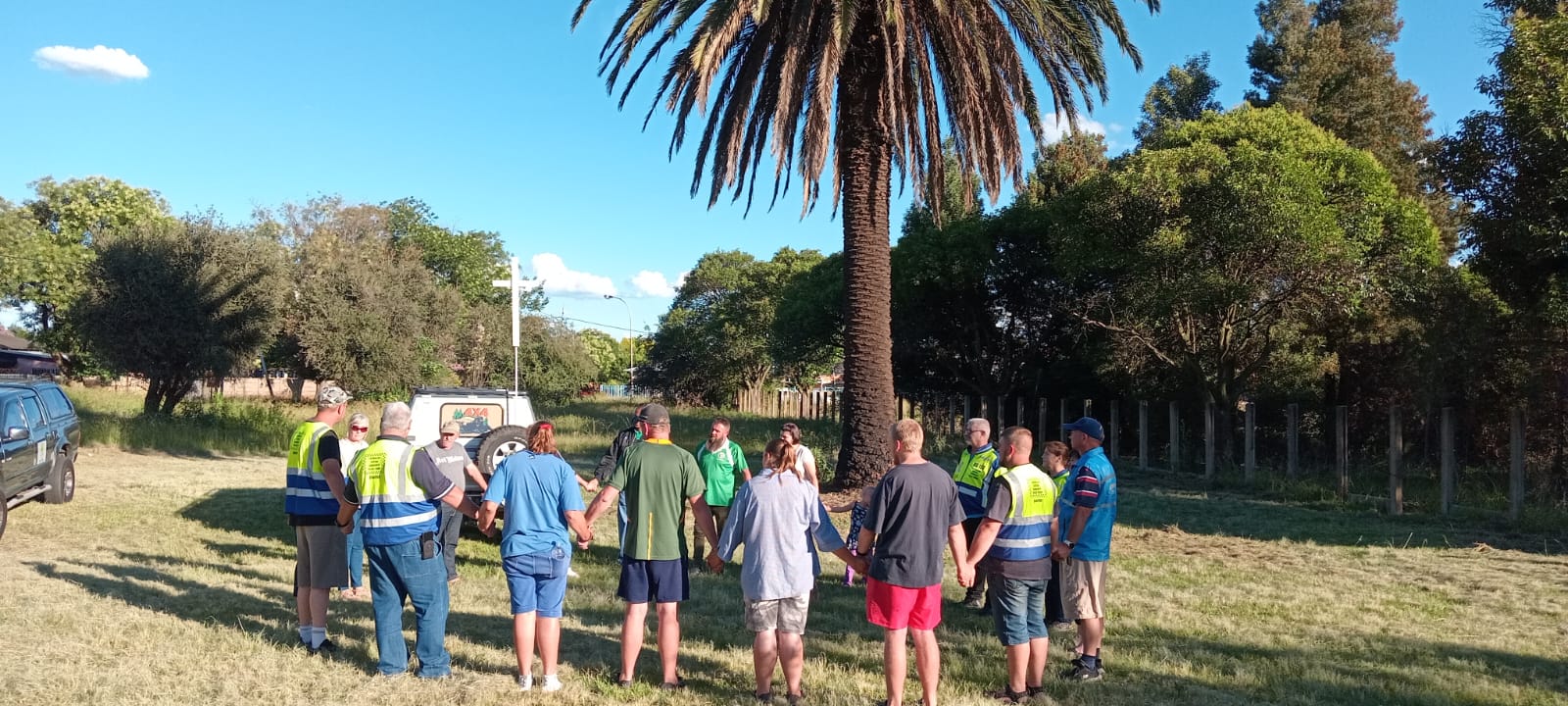
Cleanup initiative and prayer circle unite.


As in Heaven, so in South Africa.

Written by Lynelle Clark

Part of finding an open space also involves cleaning of said space. Both can be equally challenging.  

In South Africa, especially here in Brakpan, open spaces are synonymous with crime, litter, and homelessness. It has become a very tender topic that raises the ire of many of its citizens.

Some is of the belief that they pay their rates, therefore, expect service from the municipality. This has brought division into the very fabric of our society. However, a new norm has been born; rather complain about the lack of service, a group of people said, lets do something about it.

This small band is fueled by one goal; to clean Brakpan.

When I met up with them on 3 January 2024, I was truly astonished.

With a burning desire to change the culture within this town and limited resources, I didn’t know where to begin, who to ask, or who to connect with. But… there is always a but when it comes to God’s business. I know a friend. I think everybody must have a friend on speed dial who knows someone. This is exactly what happened.

When I contacted Loraine du Plessis about petrol lawnmowers, she referred me to Riaan van Zyl, which I did. This man’s value is equal to a 100 men. I left a voice message and about ten to fifteen minutes later he called, and we met up at the park. Riaan, and Lisa and Tinus Jordaan agreed to clean up the area I had in mind in Ebertson Park, Brenthurst, the following morning. For those that don’t know, the park with the burned down tennis courts opposite Spar.

Lisa and Tinus are a dynamic couple in the community. Their passion makes them highly valued.

Before I continue, I must interrupt myself by including Leon Kruger, part of the Lester Neighbourhood watch who immediately agreed to handle the security. An added value factor for those who are concerned about their safety. His team pitched up during the day and were on their post during the prayer circle.

We all pitched up at 8 am on 4 January, the day of the prayer circle with some extra hands to boot. Within hours, an area of the park transformed from an ugly eyesore to an attractive landmark. Already donations have come in and the next phase of the cleanup will continue on 6 January 2024, at 8am. Do support this dedicated team. Even a thank you or wave to acknowledge their efforts means a lot.

The very heart of the #Time2Rise initiative, an inter-denominational movement, is to connect the communities, to pray for a righteous government and to become a problem solver. The aim is for each ward in the country to have a prayer circle, which will bring unity into a divided community.


End of last year, the Lord gave me a word about mandates, and that we should take hands to do the work. No one can do it alone. No one-man-band-shows will work. Unity is the key, and in two days I have seen it happen when #CleanBrakpan #CPFBrakpan #VFParty #SafeCitiesForum #LesterBuurtwag and #SAPrayerCircles #T2R came together.


Invitation to join in prayer at Ebertson Park, Brenthurst, Brakpan.

In front of the tennis court, cnr. Lester and Heyns road.

Every Thursday evening.

Time: 5:30 - 6:30 pm

#Time2RiseSA #Time2Rise #PrayerCircle #prayers #prayforourcity #Brakpan

The only question that remains is: are you part of the solution?


Important contact information

To become part of the prayer circle, join the WhatsApp group for more information. 

To become involved with the cleanup initiative, contact Tinus and Lisa Jordaan at 073 335 3947 and like their page. Funding and donations are welcome. 

To become part of the Lester Neighbourhood watch, contact Leon Kruger at 072 022 2500

To know more about Time 2 Rise SA, visit the website or join the Facebook group.

To know more about the Safe Cities Forum and how you can help with funding, visit the website or contact Lynelle Clark 072 188 9124.

To connect with Loraine Du Plessis: Worthy Ministry Brakpan contact 072 180 0478.

ISAIAH 66:19–24 — The Global Glory and Eternal Endurance

“I will set a sign among them, and I will send some of those who survive to the nations… They will proclaim My glory among the nations.” — ...